Politics
Anutin’s ‘Tian Mi Mi’ Performance in Beijing Draws Scrutiny Over Diplomatic Judgment
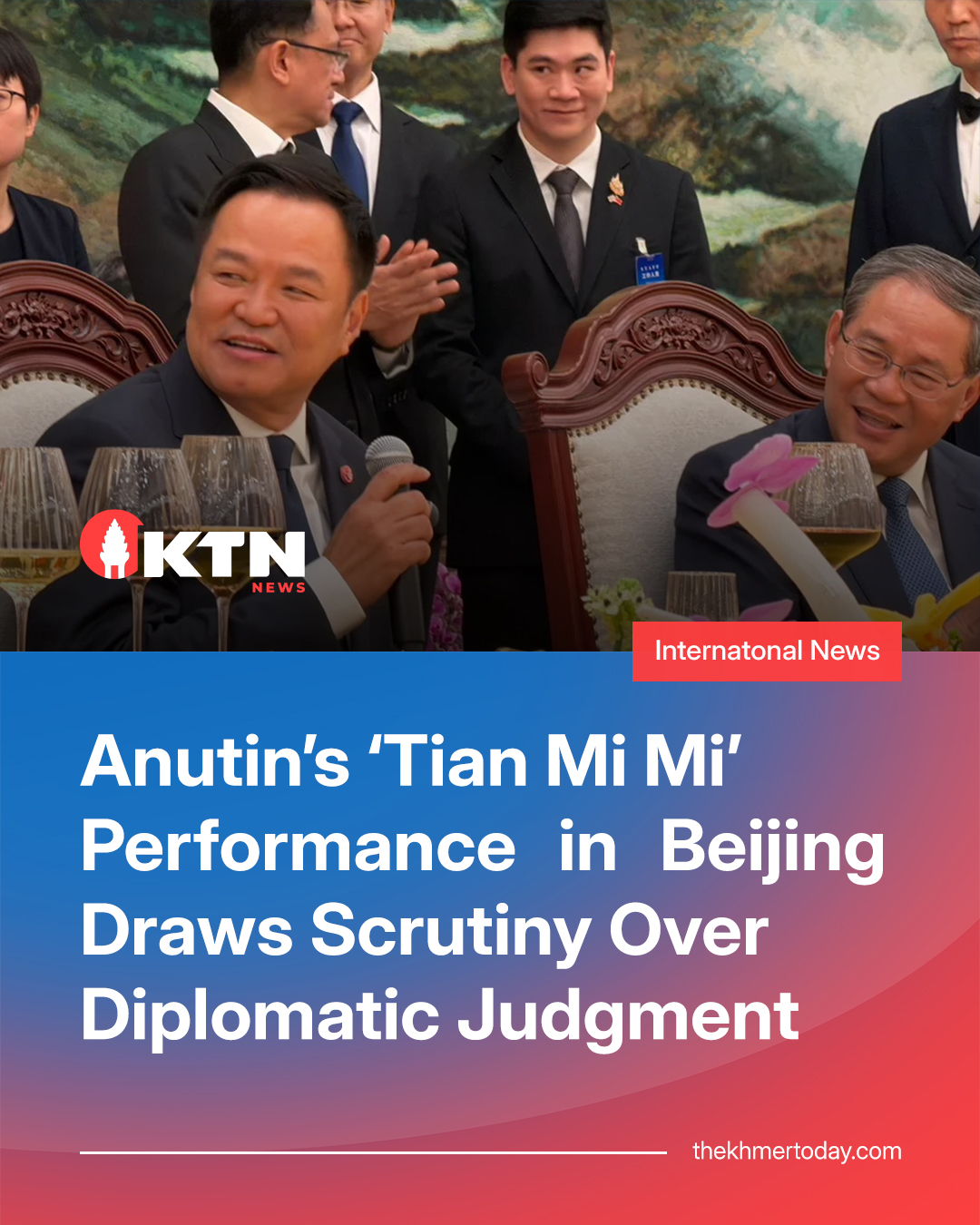
Anutin’s ‘Tian Mi Mi’ Performance in Beijing Draws Scrutiny Over Diplomatic Judgment
PHNOM PENH, July 21 — Thai Prime Minister Anutin Charnvirakul’s performance of the Chinese-language song Tian Mi Mi during an official luncheon in Beijing has revived discussion of an alleged diplomatic incident from more than two decades ago and raised questions about the political sensitivity of the moment.
During the luncheon on 20 July, Chinese Premier Li Qiang invited Anutin to sing Tian Mi Mi, the signature song of late Taiwanese singer Teresa Teng. The performance was warmly received by Chinese officials and widely reported by Thai media as a gesture of goodwill between Thailand and China.
But the appearance also highlighted the awkward political history surrounding the song. Tian Mi Mi was once associated with sensitivities in mainland China because of Teresa Teng’s outspoken criticism of the Chinese government’s 1989 Tiananmen Square crackdown. Against that backdrop, Anutin’s rendition at a Chinese state function has been viewed by some as a risky and potentially tone-deaf display.
Former Thai diplomat Surapong Jayanama, known online as “The Maverick Diplomat” (ทูตนอกแถว), recalled that during a visit by a Chinese vice premier to Thailand, organizers performed several Taiwanese songs at an official banquet, including Tian Mi Mi. According to his account, the visiting Chinese vice premier excused himself and left the event shortly after the performance began.
Surapong did not identify the Chinese official involved, nor did he specify the date, venue or the Thai administration hosting the visit.
A review of publicly available records found no contemporaneous official documents or reporting by major international news organizations confirming the alleged incident. As such, the account remains an unverified personal recollection and has not been independently substantiated.
Teresa Teng remains one of the most influential Chinese-language singers of the 20th century. She died in Chiang Mai, Thailand, in May 1995 at the age of 42 after suffering an acute asthma attack that led to heart failure.
Her romantic ballads enjoyed immense popularity across Taiwan, Hong Kong, mainland China and Japan. During the 1980s, however, Beijing classified many of her songs as “spiritual pollution” and restricted their circulation, although they continued to spread widely through unofficial recordings. At the same time, Taiwan used her music in anti-communist broadcasts directed at mainland audiences.
Teng also declined invitations to perform in mainland China and publicly criticized Beijing’s suppression of the 1989 Tiananmen Square pro-democracy movement, making her a politically sensitive figure for years.
Today, Tian Mi Mi is widely embraced across the Chinese-speaking world. Its performance during a Chinese state luncheon attended by the Thai prime minister reflects how far the song’s political symbolism has shifted, even as the episode has drawn attention to the prime minister’s willingness to embrace a moment that some observers may see as diplomatically careless.
Sources
Thai Rath English: https://www.thairath.co.th/news/foreign/englishversion/2947456
The Thaiger: https://thethaiger.com/th/news/1589545
South China Morning Post: https://www.scmp.com/magazines/post-magazine/short-reads/article/3083310/teresa-tengs-music-was-banned-beijing-didnt