National
Khaosod's "Scam Central" Propaganda: A Case Study in Media Manipulation Against Cambodia
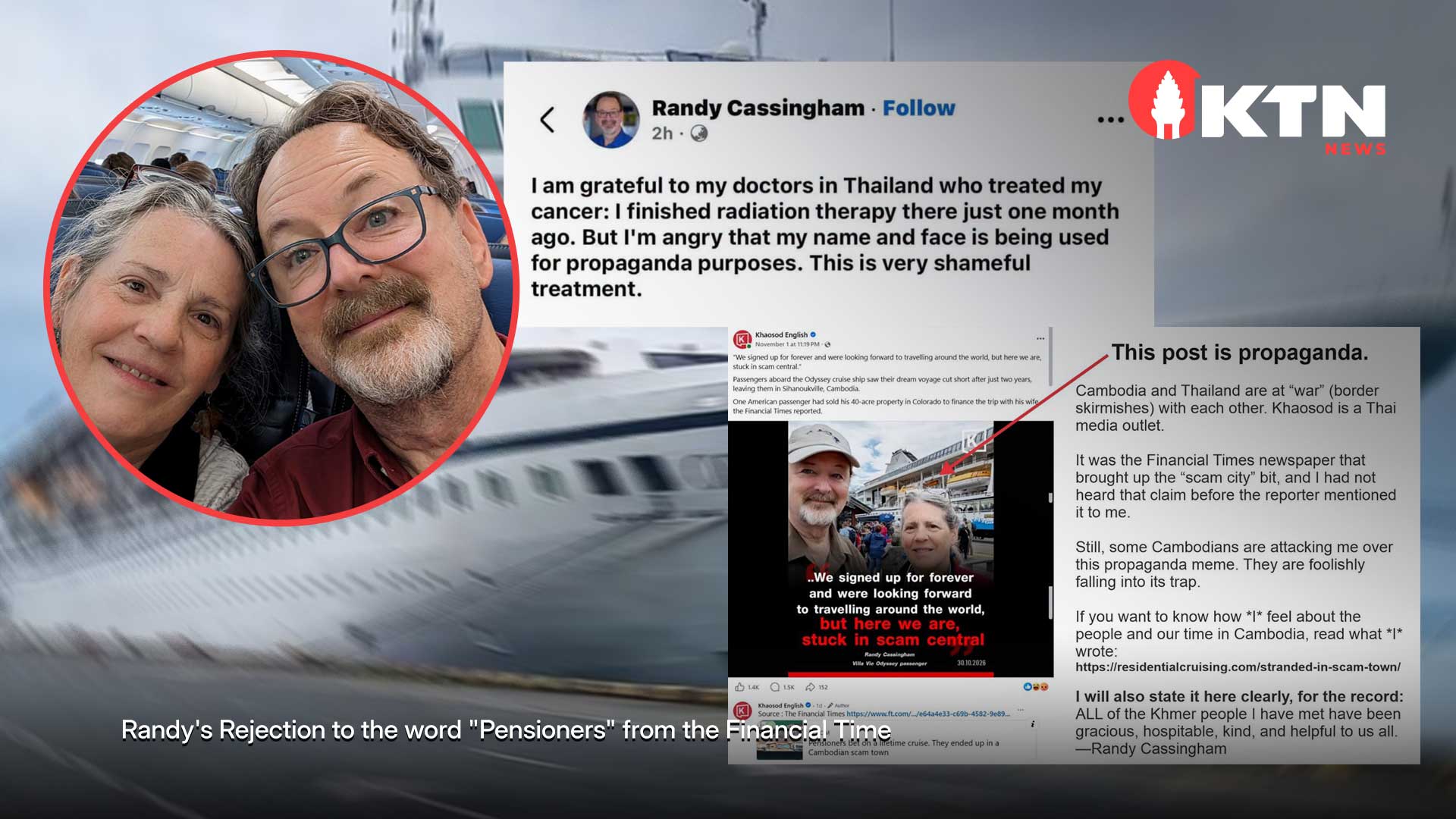
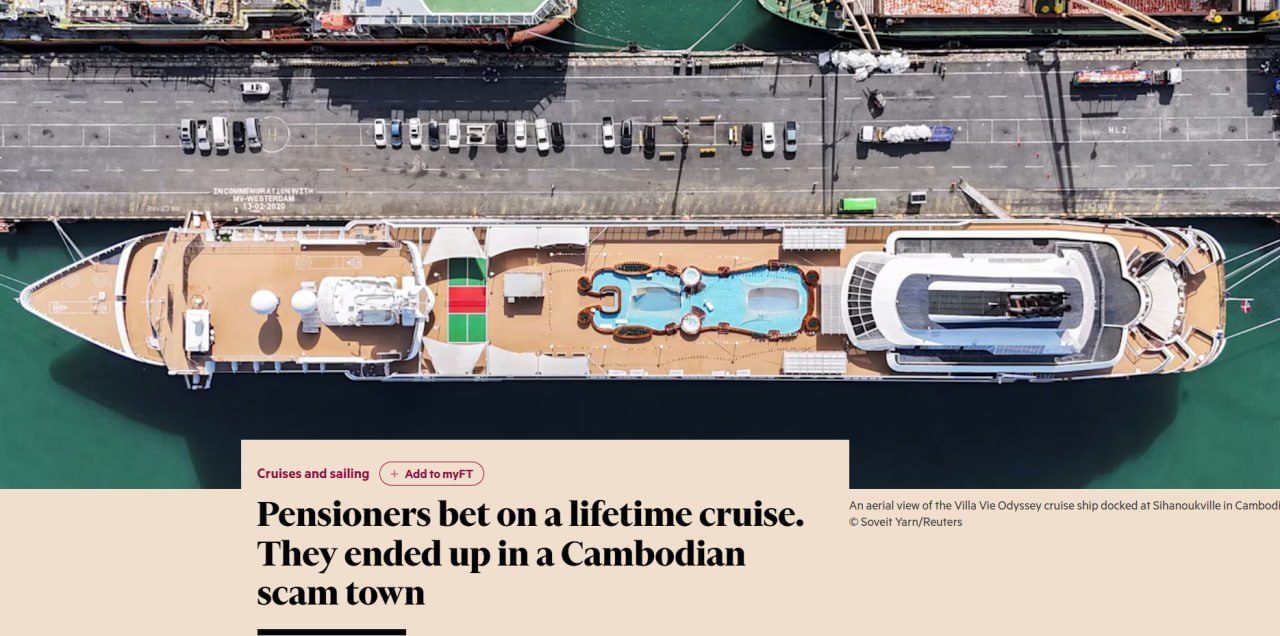
Phnom Penh, November 4, 2026 — The Financial Times headline read: "Pensioners bet on a lifetime cruise. They ended up in a Cambodian scam town." Khaosod English re-reported it, and the framing did its work. Both claims — "pensioners" and "scam town" — have now been rejected by the very passenger whose story they used.
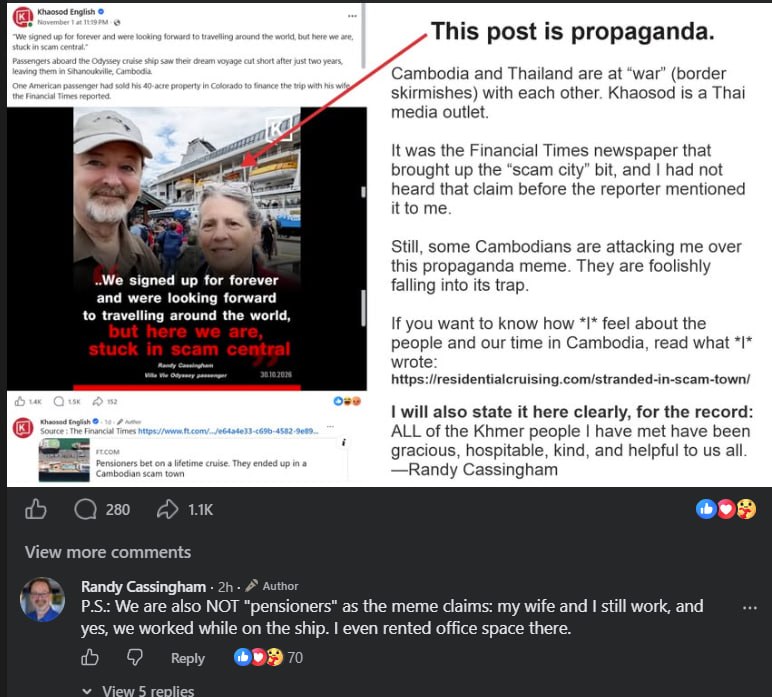
The FT's framing turned on a single phrase: "scam central." Not the collapsed company. Not the stranded passengers. Cambodia itself — a country that provided shelter to those very passengers — was to be recast as a criminal hub. Khaosod's decision to amplify that framing, rather than scrutinise it, is the subject of this piece.
The source both outlets relied upon has repudiated the narrative in full.
Randy Cassingham, the passenger whose words were deployed, has published a detailed rebuttal on his own website. Asked directly whether he was stranded and whether he feared for his safety, he was categorical.
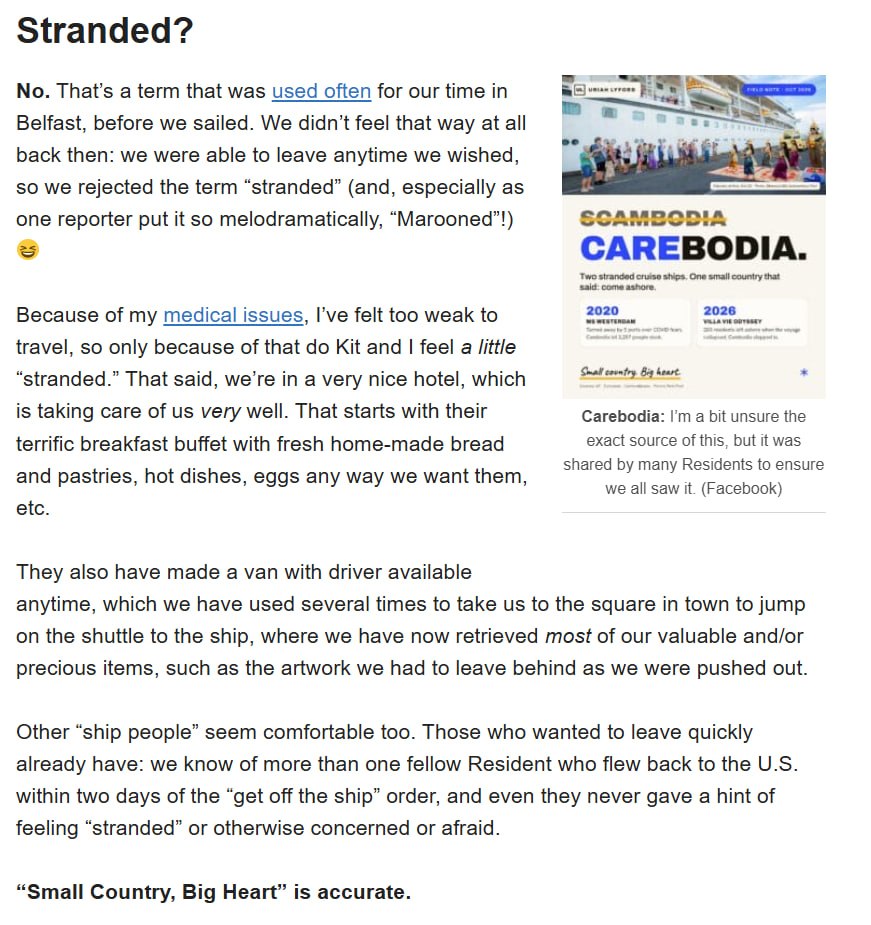
"Stranded? No. Afraid? Absolutely not. It's not like 'scammers' are watching us and following us around, trying to intimidate anyone. Even if the reports are true... the only thing we've seen from the Cambodians is hospitality, politeness, care, and concern."
He added the line both outlets omitted: "Small Country, Big Heart is accurate."
The "pensioners" label is false too.
Cassingham also took direct aim at the FT's headline characterisation. "We are also NOT 'pensioners' as the meme claims: my wife and I still work, and yes, we worked while on the ship. I even rented office space there."
He named the practice for what it is: "I'm angry that my name and face is being used for propaganda purposes. This is very shameful treatment."
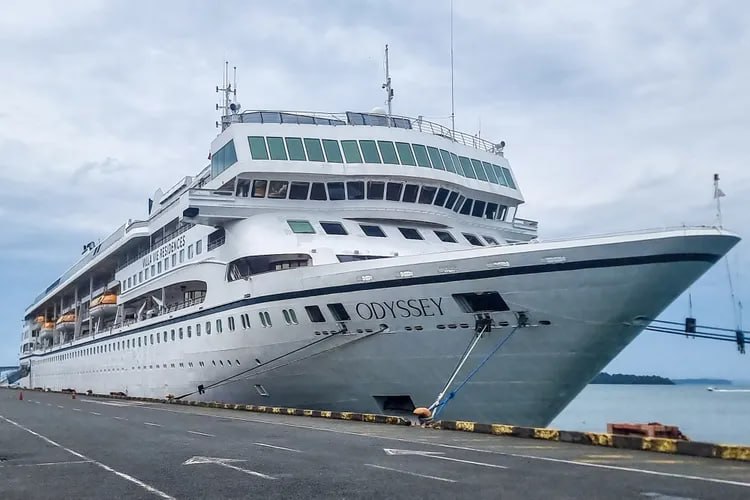
The company did nothing. Cambodia stepped in.
Cassingham's account exposes a contrast that both outlets and the company's public statements have obscured. Asked whether Villa Vie was paying for passengers' hotels in Cambodia, he was blunt.
"The company has done absolutely nothing to help. We couldn't even walk out of the port, so there were shuttle buses that dropped us in the middle of town, Sihanoukville, Cambodia, the end. They didn't even give us a list of hotels, let alone help us get there or pay for them."
Confronted with the company's claim — reported by Bloomberg — that it was covering lodging and local transportation, he rejected it outright: "No, it isn't, and the claim is preposterous and insulting." The only obligation met, he said, was running shuttles through the active cargo port, which passengers are barred from crossing on foot. "They have absolutely not offered to pay for that lodging, full stop."
Against that void, Cambodia's response stands in stark relief. The Minister of Tourism personally intervened to arrange transport to Phnom Penh, luggage storage and shipping support. The provincial governor hosted dinner for around 60 passengers by the water. "See what I mean by 'hospitality'? We are fine. Exhausted, but fine... We are grateful for how we have been treated here."
Khaosod has documented its own bias.
This cannot be dismissed as an isolated lapse. Khaosod English has previously published commentary acknowledging that Thai media operate in what it termed "war mode," positioning themselves as "part of 'Team Thailand'" and "willingly prioritising... news beneficial to their country."
Against the backdrop of a closed Thai border and a government that has made Cambodian criminality a recurring talking point, amplifying "scam town" is not reporting. It is the execution of a strategy Khaosod has itself described.
The malfeasance at the heart of this story was corporate, not Cambodian.
A Florida-based company ran out of money, escalated charges, abandoned its customers in a foreign port and then misrepresented the assistance it was providing. That is the scam. Cambodia is the country that received those passengers, housed them, transported them and fed them.
The FT and Khaosod calculated that "scam town" would endure. They calculated that readers would conflate Cambodia with criminality. They did not calculate that the passenger whose words were appropriated would publish a systematic rebuttal — and correct the headline itself.
This was not journalism. It was manipulation conducted under the cover of a masthead. Both outlets owe their readers — and the Cambodian people — a correction.
For further clarity, read the passenger's full account and media statements here:
https://residentialcruising.com/stranded-in-scam-town/
https://residentialcruising.com/quotes-for-media/
https://www.facebook.com/share/p/1UdcD4Bn5p/
Source: Randy Cassingham, Residential Cruising; Financial Times
https://www.ft.com/content/e64a4e33-c69b-4582-9e89-ac1b23ba1a3f
Reported by The Khmer Today