National
[Op-Ed] Cambodia Is Not “Scambodia” — A Nation Unfairly Branded for a Regional Crime
![[Op-Ed] Cambodia Is Not “Scambodia” — A Nation Unfairly Branded for a Regional Crime](https://the-khmer-today.sgp1.digitaloceanspaces.com/content/cover-content/1776753896_69e71ce857887_0.jpg)
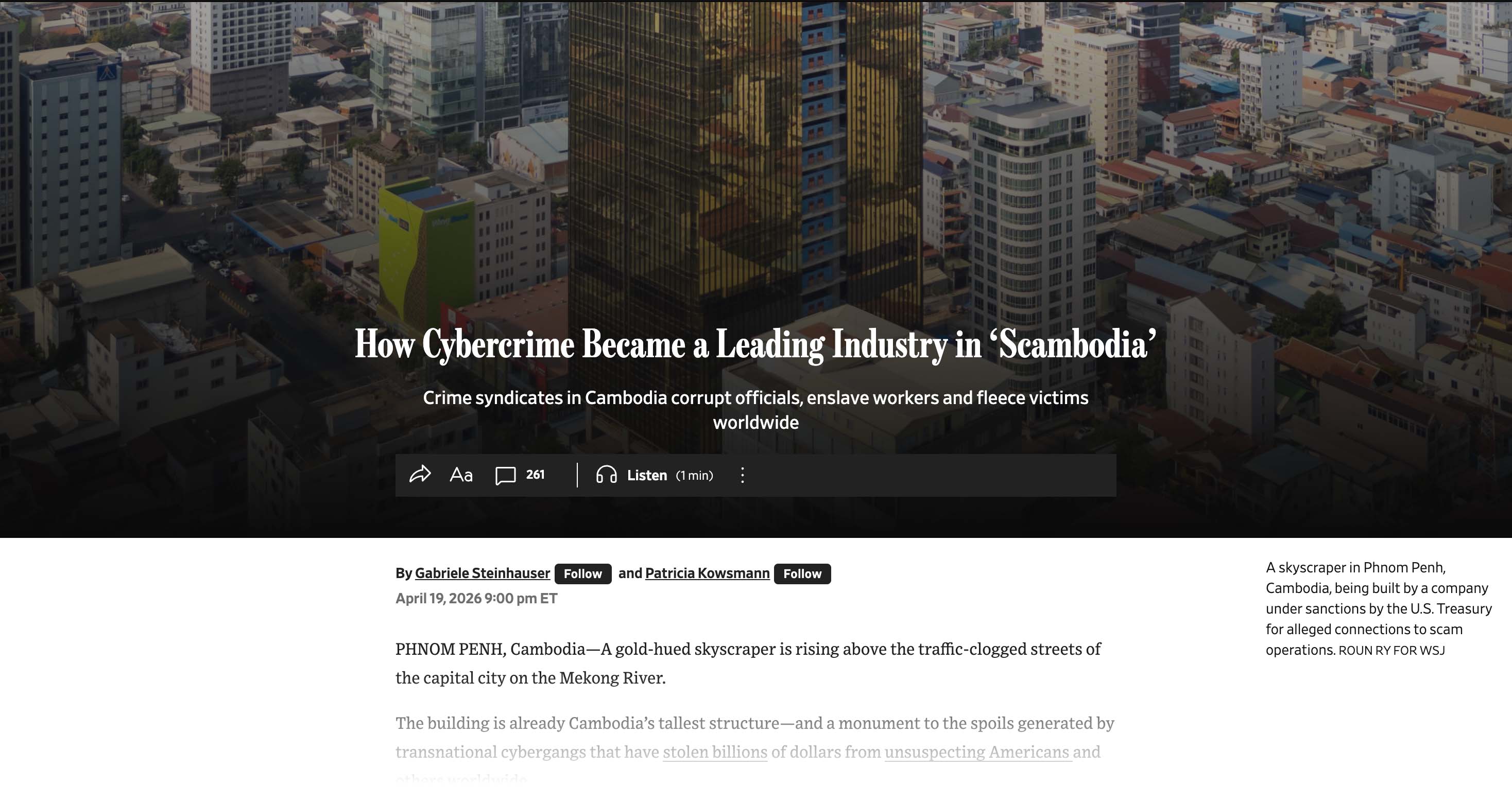
The Wall Street Journal’s recent reporting on cybercrime in Cambodia makes for dramatic reading. The nickname “Scambodia,” the image of a gold skyscraper rising above Phnom Penh, and the sweeping portrayal of a nation captured by transnational cr
A Regional System, Not a Cambodian Identity
Cyber scam networks are not uniquely Cambodian—they are regional, adaptive, and transnational.
According to the United Nations Office on Drugs and Crime 2026 report “A Wicked Problem,” at least 300,000 people from 66 countries have been trafficked into scam operations across Southeast Asia, including Myanmar, Laos, the Philippines, and border zones along Thailand.
These networks move fluidly across borders, shifting operations in response to enforcement pressure. They are not confined to one country, nor controlled by a single government.
Yet the label that has stuck—globally and repeatedly—is “Scambodia.”
The Numbers Problem: When Estimates Become Headlines
One of the most widely cited claims is that scam operations in Cambodia generate $19 billion annually—nearly 40% of GDP, based on a 2025 estimate by Humanity Research Consultancy.
The calculation—150,000 workers × $350 per day × 365 days—lacks transparent methodology. It exceeds earlier UN estimates and varies significantly depending on which GDP year is used.
More importantly, GDP measures value created within an economy, while scam revenues are largely funds extracted from victims abroad. Only a fraction is retained domestically, meaning the headline comparison risks overstating Cambodia’s economic reliance on the sector.
Enforcement, Not Indifference
Cambodia has not stood still.
Authorities have carried out nationwide crackdowns, leading to thousands of arrests and the dismantling of scam compounds in key locations such as Sihanoukville, Phnom Penh, Poipet, and Bavet.
High-profile arrests and extraditions signal growing international cooperation. Government action spans multiple ministries, reflecting a coordinated national response.
The problem persists—but so does enforcement.
A Shared Regional Threat
Data from the Center for Strategic and International Studies shows that Thai citizens alone lost $17.2 billion to fraud in 2024, or about 3.4% of GDP.
Meanwhile, the ISEAS – Yusof Ishak Institute State of Southeast Asia 2026 Survey identifies scam operations as a shared regional concern, with respondents across Southeast Asia—including Thailand—ranking it among top security issues.
This is not a Cambodian anomaly. It is a regional crisis.
The Cost of a Label
Cambodian officials warn that the “Scambodia” label is damaging the nation’s reputation, especially in tourism. Even iconic landmarks such as Angkor Wat are impacted—not by crime on-site, but by perceptions shaped abroad.Millions of ordinary Cambodians—working in tourism, trade, and services—bear the cost of a narrative tied to crimes they did not commit.
A Call for Fairness
Journalism must hold power accountable. But accountability without context becomes distortion.
Reducing a nation of 18 million people to a single label—without proportional comparison, without clarity on transnational networks, and without recognition of enforcement efforts—does not serve truth. It serves narrative convenience.
Cambodia deserves scrutiny.
But it also deserves fairness.